


Football betting turns ninety minutes into a measurable price. On 1xBet, football odds translate win chances into decimal numbers for each outcome. Those numbers react to form, injuries, and lineups. Nigerian bettors meet these shifts before kick-off and during live play. Knowing why prices change reduces blind staking and impulsive chases.
This page explains how bookmakers compute starting odds and reshape them in-play. It also shows which match factors distort predictions most. You will see market choices for tight derbies and open, attacking fixtures. Examples use NGN stakes, so payouts feel tangible. Use these notes to place 1xbet football betting with clearer intent.

How Football Odds Are Created and Why They Move
Odds start as probability estimates, then convert into decimal prices. A bookmaker builds a price using historical match data, goal rates, rating gaps, home advantage, and schedule density. That “raw” probability is adjusted by margin (overround) and liability controls, so each side contributes to the operator’s hold.
Common inputs behind opening lines:
- Team strength ratings (Elo-style or bespoke power indexes).
- Expected goals profiles (shot quality, chance volume, finishing variance).
- Home/away splits, travel distance, rest days.
- Head-to-head only as a weak secondary signal.
- Opening limits and exposure caps to manage early sharp action.
Why opening prices differ by market type
1X2 odds often carry different margin than totals and handicaps. Totals markets rely heavily on goal-distribution models, often Poisson or bivariate Poisson with calibration tweaks. Handicaps add a spread dimension, so the price balances both the line and the odds.
Why odds move
Odds movement is usually risk control plus new information. Traders react to bets that concentrate exposure, then re-price to attract money to the other side. External news accelerates price drift, especially close to kick-off.
Main triggers for odds fluctuations in football matches:
- Confirmed lineups, late scratches, tactical shifts.
- Injury reports, suspensions, fatigue markers.
- Weather swings that suppress tempo and shot volume.
- Syndicate pressure (“steam” moves) on niche leagues.
- Market liquidity changes during peak betting windows.
- Live events: goals, red cards, penalty xG, VAR reversals.
Static vs dynamic pricing examples (NGN)
Examples assume the same stake to show payout sensitivity.
| Pricing style | Situation | Market | Odds | Stake (NGN) | Potential return (NGN) |
| Pre-match (static) | Before kick-off | Home Win | 1.80 | 2,000 | 3,600 |
| Live (dynamic) | Home concedes early | Home Win | 2.60 | 2,000 | 5,200 |
| Pre-match (static) | Before kick-off | Over 2.5 Goals | 1.95 | 2,000 | 3,900 |
| Live (dynamic) | 1–0 at 20’ with high shot volume | Over 2.5 Goals | 1.55 | 2,000 | 3,100 |
Using price moves on 1xBet
Use the match page to compare pre-match lines with 1xbet football live prices. Track whether a move follows verified news or pure money flow. If you ask “how to bet on 1xbet football,” start by linking your stake size to volatility: live markets swing faster, so trim stake and avoid stacking impulsive add-ons.
Key Factors That Shape Football Outcomes
Football outcomes combine skill, tactics, and randomness. Strong teams still lose because goals are low-frequency events. Good prediction separates stable signals (team strength) from noisy signals (recent scorelines without context). This is where 1xbet football prediction work becomes practical: you are pricing uncertainty, not chasing certainty.

Team-related factors
Ranked by typical predictive weight:
- Squad quality and role fit (especially goalkeeper and striker profiles).
- Tactical matchup (press resistance, width control, transition defence).
- Fitness and load (minutes played, recovery gaps, travel).
- Finishing and set-piece efficiency (repeatable at team level).
- Manager intent (rotation risk, game-state conservatism).
External elements
External variables can flip tempo and shot quality:
- Pitch condition and rainfall intensity.
- Venue travel and altitude effects.
- Referee card rate and foul threshold.
- Crowd pressure in high-stakes derbies.
- Schedule context, including continental travel.
Models bettors use to convert factors into numbers
Statistical tooling often blends:
- Poisson goal models for totals and correct scores.
- Elo-type rating systems for baseline team strength.
- xG-based regressions to reduce finishing noise.
- Bayesian updating for late lineup information.
On a typical 1xbet football game page, look for form lines, standings, head-to-head, and live timelines. Use those data points to sanity-check your own angle, then pick a market that fits the signal you trust.
Odds impact example (NGN framing)
Below is an illustration of how one factor can reshape price.
| Factor | Example event | Win probability | Decimal odds | Stake (NGN) | Potential return (NGN) |
| Key injury | Star striker ruled out | 60% → 40% | 1.50 → 2.50 | 2,000 | 3,000 → 5,000 |
| Tactical shift | Team switches to low block | 55% → 50% | 1.82 → 2.00 | 2,000 | 3,640 → 4,000 |
| Weather | Heavy rain reduces pace | Over 2.5: 52% → 45% | 1.92 → 2.22 | 2,000 | 3,840 → 4,440 |
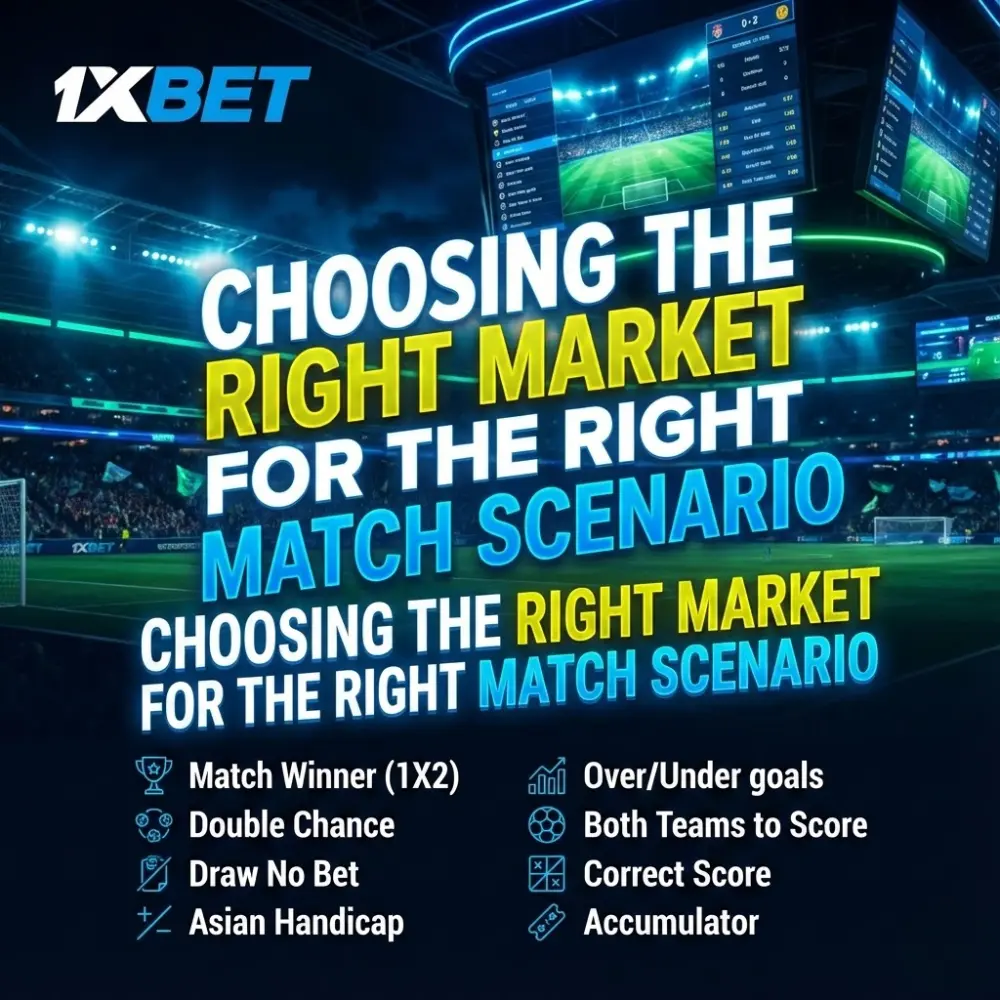
Choosing the Right Market for the Right Match Scenario
Different markets reward different information. If your read is about goals, totals and team totals fit better than 1X2. If your read is about mismatch intensity, handicaps can express it cleanly.
Popular football markets on 1xBet:
- Match Winner (1X2).
- Double Chance.
- Draw No Bet.
- Asian Handicap (line-based spreads).
- Over/Under goals (match or team totals).
- Both Teams to Score.
- Correct Score and Scorecast (high variance).
- Accumulator (multi-leg) slips for correlated angles.
Matching markets to scenarios
High-tempo matches with frequent box entries suit totals and BTTS. Cagey derbies with low shot quality often suit unders, draw-protection markets, or small handicap lines. When you use the 1xbet football app, focus on one dominant scenario per bet, not five weak narratives.
Risk assessment by match profile
- Big favourite with rotation risk: avoid short 1X2 prices; consider handicap or team total.
- Two uneven defences: BTTS can price chaos better than a winner market.
- Underdog with counter threat: take positive handicap instead of pure upset.
- Early red-card volatility live: reduce stake size, avoid chasing multiple re-entries.
Scenario-to-market examples (NGN)
| Scenario | Market choice | Example odds | Stake (NGN) | Potential return (NGN) |
| Open match, high xG trend | Over 2.5 Goals | 1.90 | 3,000 | 5,700 |
| Tight derby, low tempo | Under 2.5 Goals | 1.85 | 3,000 | 5,550 |
| Strong favourite, safer cover | Draw No Bet (Favourite) | 1.45 | 4,000 | 5,800 |
| Underdog has structure | +1 Handicap (Underdog) | 1.70 | 3,000 | 5,100 |
| Mixed slate, higher variance | Accumulator (3 legs) | 5.00 | 1,000 | 5,000 |
Place “how to bet on 1xbet football” into practice by selecting a market that matches your evidence. If your evidence is weak, shorten odds ambition, not your bankroll.
Where Professional Bettors Gather Reliable Match Insights
Professional bettors prioritise verifiable information. They avoid rumor-heavy feeds unless confirmed by an official channel.
Common reliable inputs:
- Official league and club channels for lineups and suspensions.
- Match reports and press conferences from credentialed journalists.
- Data platforms providing event data, xG, and shot maps.
- Injury trackers that cite team medical updates.
- Betting exchange or market screens to see liquidity and moves.

Community and expert layers
Forums and tipsters are noisy, but they can surface early lineup hints. Treat these as leads, then validate elsewhere. Use 1xbet football prediction content only when it states a method, not just a pick.
How data gets assembled
Most betting data flows through automated feeds: fixtures, lineups, events, and odds snapshots. Some services use APIs from data vendors; others combine scraping plus manual verification. Paid stat packs can cost around NGN 5,000/month, depending on provider and feature depth.
Source matrix with practical linkage to 1xBet
| Source type | Pros | Cons | How it pairs with 1xBet features | Typical cost (NGN) |
| Official league site | Accurate squads, discipline | Limited advanced metrics | Confirm lineup, then compare pre-match vs live centre prices | 0 |
| Club media | Fast injury context | Can be selective | Validate availability before staking | 0 |
| Paid analytics platform | xG, shot maps, models | Subscription cost | Use metrics to choose totals or handicaps | 5,000 / month (example) |
| Journalist reports | Timely team news | Needs verification | Cross-check before entering 1xbet football live markets | 0 |
| Community forums | Early whispers | High noise | Use only as a prompt to verify elsewhere | 0 |
Conclusion
Football prices move because information and money flow never stop. Pre-match odds reflect probability, margin, and exposure limits. Live odds respond to events, tempo shifts, and stake pressure within seconds. Nigerian bettors get better control by separating stable signals from noise, then choosing a market that fits one clear scenario. On 1xBet, use match stats, the live centre, and mobile access to compare lines, verify team news, and size stakes to volatility. This approach keeps 1xbet football betting structured, even when matches turn chaotic.